




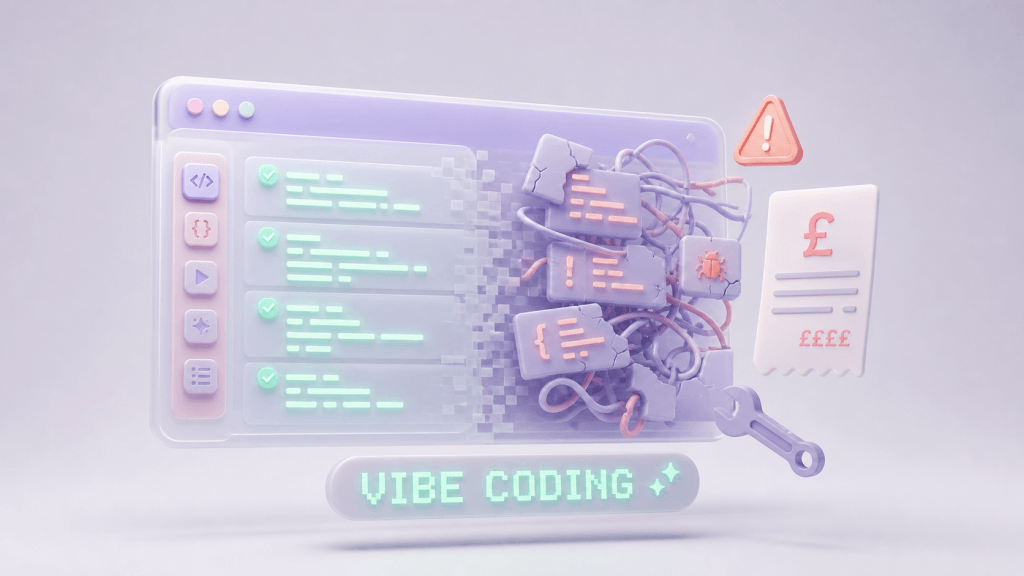
AI coding tools have made it possible to turn an idea into a website, portal or application faster than ever before.
Describe what you want, approve a few suggestions and, in a surprisingly short time, you may have something that appears to work. This approach is often called vibe coding: building software primarily through natural-language instructions, with an AI tool generating much of the code.
For prototypes and early-stage experiments, this can be incredibly useful. The danger begins when a prototype is treated as a finished, production-ready application without an experienced developer checking what sits underneath it.
An app may look polished while containing security vulnerabilities, duplicated logic, poor database decisions or dependencies that will make future changes increasingly difficult. When something eventually goes wrong, the cost is rarely limited to correcting one faulty line of code.
You may have to pay someone to understand an unfamiliar system, identify connected problems, protect existing data and possibly rebuild large parts of the application.
The short answer: how much does it cost to fix AI-generated code?
The cost of fixing AI-generated code depends on the size of the application, the quality of the original build and whether the problem affects security, data or core architecture.
A small, isolated issue might take a developer a few hours to resolve. A poorly structured application may require days or weeks of investigation and refactoring. In serious cases, rebuilding the application can be safer and more economical than continuing to patch it.
The important point is this:
The cost of repairing an application is not based only on how long the final fix takes. It also includes the time required to understand code that nobody properly designed, documented or reviewed.
That investigation can become the most expensive part of the job.
What is vibe coding?
Vibe coding is an informal term for creating software by describing the desired result to an AI coding tool and allowing it to generate much of the implementation.
Rather than manually planning and writing every component, the person building the product might enter instructions such as:
- “Build me a customer booking system.”
- “Add user accounts and online payments.”
- “Create an admin dashboard.”
- “Fix this error.”
- “Make the application ready to launch.”
The tool can produce impressive results, particularly when the request involves a familiar interface or common feature. However, producing code and engineering reliable software are not the same thing.
A professional application also needs decisions about architecture, access control, data protection, validation, backups, performance, testing, deployment and long-term maintenance.
AI can help an experienced developer work through these decisions. It cannot guarantee that an inexperienced user has asked the right questions—or recognised a dangerous answer.
Is AI-generated code bad?
No. AI-generated code is not automatically bad, just as human-written code is not automatically good.
AI is a tool. Its value depends heavily on who is directing it, reviewing its output and taking responsibility for the finished product.
Experienced developers can use AI to accelerate repetitive work, explore solutions, produce test cases and improve documentation. Crucially, they can also recognise when the output is insecure, unnecessarily complex or simply wrong. (If you’re weighing up this decision for your own site, we’ve written more about it in Should I hire a WordPress developer or build my site myself using AI?)
The risk increases when someone can generate an application but cannot:
- explain how its main components work;
- review the code for security problems;
- test unusual and unexpected situations;
- assess whether the underlying structure can scale;
- safely update or deploy it;
- recover the system if an update fails;
- maintain it when the original AI conversation is no longer available.
This is why businesses should ask who is actually engineering the product—not merely who can make an AI tool generate it.
Why can cheap AI development become expensive later?
1. A new developer must first reverse-engineer the application
When experienced developers take over an existing project, they cannot safely start changing things immediately. They need to understand:
- how the application is structured;
- where and how its data is stored;
- which external services it depends on;
- how users are authenticated;
- how permissions are controlled;
- what happens when an operation fails;
- whether tests, backups and documentation exist.
This process is often called technical discovery or a code audit.
If the application has grown through hundreds of loosely connected prompts, there may be no coherent architecture to follow. The developer has to reconstruct the logic piece by piece before making a safe repair.
You are therefore paying for investigation before the repair itself can begin.
2. Fixing one problem may expose several more
Poorly structured applications are often tightly coupled. This means one feature relies on another in ways that are not obvious.
A developer may repair the checkout process only to discover that the change affects customer accounts, stock records or confirmation emails. A login problem might lead to a wider discovery that permissions were never implemented correctly.
These connected faults make estimates difficult. What appears to be a one-day repair can become a much larger recovery project once the underlying code is examined.
3. Automated fixes can create a patchwork codebase
When an AI tool receives an error, it usually tries to make that error disappear using the context it has available. That does not always mean it has identified the underlying cause.
Repeatedly asking AI to “fix” new errors can create layers of workarounds:
- A generated feature causes an error.
- Another prompt produces a patch.
- That patch causes a different issue.
- A further patch changes another part of the system.
- Nobody removes the now-redundant code.
Eventually, the application may contain multiple ways of doing the same job, unused files and contradictory rules. This is a form of technical debt: the application still works, but every future change becomes slower and riskier.
4. Security problems are more expensive than ordinary bugs
A visual defect is inconvenient. A security failure can affect customers, finances, business operations and regulatory responsibilities.
Potential problems include:
- exposed passwords or API credentials;
- weak authentication;
- users gaining access to other users’ information;
- payment processes being implemented incorrectly;
- unvalidated form or file uploads;
- sensitive information appearing in logs;
- insecure third-party packages;
- databases that can be accessed without proper restrictions.
OWASP warns that people relying on AI-generated code without sufficient security expertise may unintentionally introduce security misconfigurations. Its secure coding guidance also advises teams not to treat AI-generated tests as proof that software is secure.
Security repairs may involve more than changing the code. A business might also need to reset credentials, investigate access logs, notify affected parties, restore data or temporarily take the service offline.
5. A weak data structure can force a major rebuild
Interfaces can be redesigned relatively easily. Incorrect data architecture is much harder to change.
For example, a booking platform might initially store customers, appointments and payments in a structure that works for a small demonstration. As real customers begin using it, the business may discover duplicate records, missing relationships or no reliable way to produce reports.
Correcting this can require:
- designing a new database structure;
- cleaning existing information;
- creating migration scripts;
- validating the migrated records;
- preventing data loss;
- updating every feature that uses the old structure.
At that stage, the business is no longer paying for a small improvement. It is paying to replace the foundations while attempting to keep the building open.
6. Missing tests make every repair riskier
Automated tests help developers confirm that important behaviour still works after a change. Without them, each repair requires more manual checking. There is also a greater chance that fixing one feature will quietly break another.
AI can generate tests, but those tests still need professional review. A tool may create tests that confirm its own assumptions rather than the actual requirements of the business.
The result can be a reassuring list of passing tests that never checks the most important risks.
7. The application may depend on tools nobody has recorded
AI-built products often combine hosting platforms, databases, authentication providers, email services, payment gateways, APIs and third-party libraries.
If these services are not properly documented, the next developer must work out:
- which accounts own them;
- how they are configured;
- where credentials are stored;
- what each service costs;
- whether a service can be replaced;
- what happens if a subscription expires;
- whether the business can export its data.
This is both a technical and commercial risk. Your application should not depend on an account, platform or AI conversation that the business cannot access.
What makes up the total cost of ownership?
The launch price is only one part of an application’s true cost. A more useful calculation is:
Total cost of ownership = initial build + review + hosting + maintenance + updates + security + incident recovery + eventual replacement
A low initial quote can be misleading if the application requires significant corrective work soon after launch.
| Cost area | What you may eventually pay for |
|---|---|
| Technical discovery | Understanding undocumented code and services |
| Bug fixing | Reproducing faults and repairing connected issues |
| Refactoring | Replacing duplicated or fragile code |
| Security | Audits, remediation and incident response |
| Data migration | Restructuring and cleaning existing records |
| Testing | Creating missing automated and manual checks |
| Performance | Resolving slow pages, queries or integrations |
| Deployment | Creating a safe process for releasing updates |
| Documentation | Recording architecture, accounts and procedures |
| Rebuilding | Replacing parts—or all—of the original application |
The cheapest route to a working demo is not necessarily the cheapest route to a reliable business system.
Could it cost more to repair the app than to build it again?
Yes. A rebuild may be recommended when:
- the basic architecture is unsuitable;
- security cannot be confidently restored;
- the application has no meaningful tests;
- every change causes new failures;
- the original code is excessively duplicated;
- important business rules are scattered throughout the project;
- the chosen platform cannot support future requirements;
- the business does not control critical accounts or infrastructure.
This does not mean developers prefer to throw work away. A responsible developer should first identify which parts can be retained.
However, repeatedly paying for short-term patches can be more expensive than moving the useful features and data into a properly planned system.
Who should be trusted with an AI-generated application?
The question is not simply whether a person uses AI. Many capable developers use AI-assisted tools as part of their workflow.
Instead, look for someone who can demonstrate software development knowledge independently of the tool. Before giving someone responsibility for your application, ask:
Can they explain the architecture?
They should be able to describe the main components, how they interact and why particular technologies were chosen. An answer consisting only of platform names is not enough.
Do they use version control?
Version control creates a history of changes and allows work to be reviewed or reversed. For a serious application, this should be a basic part of the development process.
Is the code reviewed?
AI-generated code should be treated like code submitted by a junior team member: useful, but requiring inspection. Ask who reviews it and what qualifications or experience that person has.
How is security tested?
Look for a clear answer covering authentication, permissions, input validation, dependencies, secret management and data protection. “AI checked it” is not a security process.
Are there automated tests?
Ask which important user journeys are tested and what happens before a new version is released.
Who owns the accounts and code?
Your business should have appropriate access to the source code, domain, hosting, database, third-party services and backups.
Is there a recovery plan?
Find out how often backups run, how they are tested and how long restoration would take.
Is documentation included?
Another competent developer should be able to take over the application without starting an archaeological excavation.
Will the product receive ongoing maintenance?
Launching an application is not the end of development. Software needs updates, monitoring and security maintenance throughout its life.
Red flags when someone offers to build your app with AI
Proceed carefully if you hear statements such as:
- “You will never need a developer.”
- “AI makes testing unnecessary.”
- “Security is handled automatically.”
- “The app is finished because the demo works.”
- “We can add unlimited features without affecting the structure.”
- “There is no need to document it.”
- “Only I have access to the hosting or database.”
- “We do not need backups because everything is in the cloud.”
- “Just keep prompting it until the error goes away.”
AI can shorten parts of the development process. It does not remove engineering responsibility.
How can businesses use vibe coding more safely?
Vibe coding is most useful when its limits are understood. A business can reduce its risk by following a staged approach.
Use it to validate the idea
A prototype can help demonstrate a workflow, collect feedback or test whether customers understand a concept. Avoid placing sensitive or irreplaceable data into an unreviewed prototype.
Involve an experienced developer before launch
A professional review is most valuable before the application becomes business-critical. Problems are usually easier to correct before customers, payments and large amounts of data are involved.
Separate prototypes from production systems
Treat the prototype as a description of what to build, not necessarily the final foundations. Some code may be reusable, but it should earn its place through review and testing.
Establish ownership from the beginning
Keep the source code, hosting, domain, database and service accounts under appropriate business control.
Budget for maintenance
Every application changes over time. Include monitoring, software updates, backups, security reviews and future development in your budget.
What should you do if you already have an AI-built app?
Do not panic, and do not assume that it must automatically be rebuilt. The sensible first step is an independent technical review.
A developer should examine:
- the source code and project structure;
- authentication and user permissions;
- database design and data protection;
- third-party services and dependencies;
- hosting and deployment;
- backup and recovery arrangements;
- automated test coverage;
- known errors and performance problems;
- access to accounts, credentials and documentation.
Following the review, the application can normally be placed into one of three categories:
- Maintain: The foundations are reasonable and only minor improvements are required.
- Refactor: The application can be retained, but important parts should be reorganised or replaced.
- Rebuild: The risk and cost of continued patching outweigh the value of the existing code.
This gives the business evidence on which to make a decision, rather than continuing to spend money whenever the next problem appears.
AI should accelerate experience—not replace it
AI-assisted development is likely to remain an important part of modern web and software development. Used responsibly, it can reduce repetitive work and help experienced teams deliver faster.
But speed is only valuable when the resulting product is secure, understandable and suitable for its purpose.
The person creating your application does not need to avoid AI. They do need enough development experience to know when the output is wrong, when a shortcut is creating future risk and when a prototype is not ready for real customers.
That distinction may determine whether your application becomes a valuable business asset or an expensive recovery project.
Need an independent review of an AI-built website or application?
If you have built a website, portal or application using AI—or someone has delivered one to you—Cloud Digital can help you understand what you actually have before you invest further.
We can review the project, identify technical and security risks, and explain whether the best option is to maintain, improve or rebuild it.
Explore our web design and development services or request a quotation.
Frequently asked questions
How much does it cost to fix AI-generated code?
The cost depends on the application’s size, structure and risk level. A small isolated fault may take only a few hours, while an undocumented application with security or architectural problems can require extensive refactoring or a complete rebuild. A technical audit is usually needed before a reliable estimate can be provided.
Is vibe coding suitable for a business application?
It can be useful for prototyping and testing an idea. Before the application handles customers, payments or sensitive data, an experienced developer should review its architecture, security, testing and deployment process.
Can a developer take over an AI-generated application?
Usually, yes. The difficulty depends on the quality of the code, documentation, tests and account access. The first stage is normally a code audit and technical discovery process.
Is AI-generated code secure?
It can be secure, but it is not secure by default. Generated code requires the same professional review, testing and monitoring as any other code—and potentially more scrutiny when the person prompting the tool lacks security experience.
Is it cheaper to repair or rebuild an AI-coded app?
That can only be determined after reviewing the existing application. Repair is normally preferable when the foundations are sound. Rebuilding may cost less over time when the architecture, security or data structure is fundamentally unsuitable.
What is technical debt in AI-generated code?
Technical debt is the future cost created by shortcuts, duplicated logic, weak structure, missing tests or undocumented decisions. The application may work initially, but every later change becomes slower, riskier and more expensive.
What should I ask an AI app developer before hiring them?
Ask about their software development experience, code review process, security testing, version control, automated tests, documentation, backups and ongoing maintenance. You should also confirm that your business will have suitable access to the code and all essential accounts.